Story
21 April 2026
Rebuilding with Purpose: Women Driving Ukraine’s Industrial Recovery
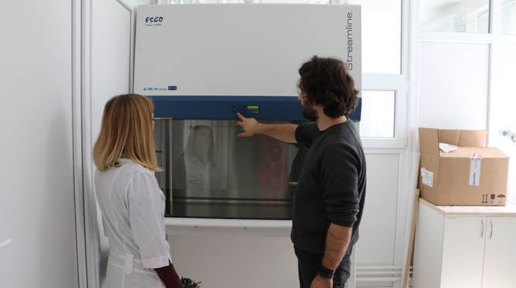
Across Ukraine, women are stepping into roles that go far beyond maintaining continuity. They are restoring production, rebuilding businesses, restoring and strengthening technical systems and introducing new approaches across sectors. In doing so, they are responding to immediate challenges while actively shaping the future of Ukraine’s industrial landscape.Their contributions span sectors and scales: from micro- and small enterprises rebuilding local communities and economies to engineers reinforcing industrial standards and quality, from sector leaders adopting advanced technologies and innovative business practices to entrepreneurs developing the next generation of sustainable and innovative solutions.Taken together, these stories reveal a broader transformation – one in which rebuilding is not simply about restoring what was lost, but about redefining how industry functions.Rebuilding livelihoods and local economiesFor many women, recovery begins not with investment strategies or policy frameworks, but with a firm decision: to stay in the country despite all challenges, to rebuild and to start again. Yulia Dobrutska’s story captures that reality with particular clarity. After losing the business she and her husband had built in Kyiv and relocating to Lutsk, they had to begin almost from zero. What followed was not an abstract idea of resilience, but a very practical process: reinvesting every available resource, acquiring equipment step by step and gradually launching their knitwear brand, Bavna.At one point, they considered shifting entirely to a different business just to survive. Training and mentoring provided through a UNIDO initiative helped them reassess that path and instead build on the expertise they already had. “Our contribution to the economy is simply that we stayed,” Yulia says. “We could have gone abroad, but we chose to live, work and grow here.” In a moment when leaving often felt like the only rational choice, staying became a deliberate decision to rebuild not only a business, but a future.That decision – to stay – carries economic weight in today’s Ukraine. It sustains jobs, preserves skills and maintains production capacity at a time when many businesses are forced to scale down.Similar stories are unfolding across western Ukraine. In Lviv Oblast, women such as Maryna Kosarieva, founder of the StekloCraft brand specializing in stained-glass design and Olena Trofymenko, who founded the artisanal cheese dairy CheeseFaino in Truskavets, rebuilt their businesses after forced displacement, transforming disruption into a new phase of development. Their journeys reflect a shift from survival to stability – where businesses are not simply restored, but restructured with clearer planning, stronger market positioning and a longer-term vision. For Maryana Yaskiv, the path into entrepreneurship came from everyday necessity. A former teacher, she and her husband opened a small grocery store in their village – a decision that quickly evolved into managing finances, staff and operational risks, including energy disruptions. “Now I am the employer who calculates salaries. Financial planning and budgeting suddenly become very real responsibilities,” she explains. The business continues to grow, with plans for expansion and investment in solar energy.Svitlana Moshchych’s work with peonies tells a similar story of transformation. What began as a passion became a structured business combining cultivation, breeding and online sales. “The Bulgarian-funded UNIDO project gave me an opportunity to systematize my knowledge and learn modern approaches to business,” she explains – a reminder that structure is often the turning point between effort and sustainability.Within Spromozhna, an initiative founded by Promprylad Foundation, women such as Olha Pylypiv and Marta Kliashtorna are building businesses rooted in both creativity and social impact. Their stories are part of one of the initiative’s programmes supported by UNIDO under its Austria-funded project. From architectural materials to inclusive tourism spaces, their work expands how industrial recovery is understood – not only as production, but as a broader ecosystem of services, design and local enterprise. These individual stories reflect one layer of transformation. As businesses cannot grow in isolation. Recovery also depends on the systems that enable industries to function, compete and access markets.Strengthening the foundations of industryRecovery does not depend on businesses alone. It also relies on the systems that allow industries to function.Across Ukraine, women are contributing to the technical backbone of industrial recovery – strengthening laboratories, testing systems and quality infrastructure that underpin competitiveness and access to markets.At BM-TEST in Rivne, this shift became particularly visible after many male engineers were mobilized. As Laboratory Manager Halyna Fursachyk recalls, the question was immediate and practical: who would continue carrying out the technical work? “The answer was clear: the women.”With UNIDO support, they underwent specialized training based on European methodologies, gained access to advanced equipment and software and helped bring the laboratory to a new level of technical capacity aligned with EU standards. For engineers like Olha Nepomiascha and Kateryna Kostiukevych, this is not simply about continuity. It is about redefining professional roles. Testing becomes part of a broader system of trust – ensuring that Ukrainian products meet international standards and can compete globally.In value chains such as berries and nuts, supported through the Switzerland-funded UNIDO Global Quality and Standards Programme, women entrepreneurs are also strengthening compliance, branding and export readiness. Businesses like “Nuts’N’Garden” and “Food for Thoughts” demonstrate how technical support translates into market access, linking local production with global demand. This work may remain largely invisible to the public. Yet without it, recovery cannot translate into long-term growth.Efficiency, sustainability and industrial transformationAs industries rebuild, efficiency and sustainability are becoming central to how production is organized.Within the UNIDO Global Eco-Industrial Parks Programme in Ukraine, supported by Switzerland, enterprises are working to reduce energy consumption, optimize resource use and integrate circular approaches into production processes.For professionals like Liudmyla Tereshchenko, Deputy Director, Trivium Packaging Ukraine, this work means translating sustainability from policy language into operational practice – identifying concrete ways to reduce waste, lower costs, integrating energy management systems and strengthen competitiveness. These changes are incremental, but cumulative. They represent a shift toward a more resilient and resource-efficient industrial model, where sustainability is not an external requirement, but a driver of performance.Technology, partnerships and co-creationRecovery is not only about restoring existing systems. It is also about introducing new ones.Through the Japan-funded UNIDO “Green industrial recovery project for Ukraine through technology transfer from and co-creation of new businesses with Japan's private industries,” advanced technologies are being tested and adapted across the Ukrainian industrial landscape. In Mykolaiv, AI-based systems are being used to monitor road conditions in real time, allowing municipalities to prioritize repairs and manage infrastructure more effectively. For Hanna Montavon of Mykolaiv Water Hub, the significance of this goes beyond technology: “When women lead in industry, innovation becomes more inclusive and solutions become more sustainable. This project connecting Japanese technology with Ukrainian expertise shows that cross-border collaboration, driven by diverse perspectives, can transform how we maintain and recover critical infrastructure.”A similar transformation is taking place in agriculture. In the pig farming sector, cooperation with the Japanese company Eco-Pork is introducing AI-driven tools that improve productivity, optimize resource use and support more sustainable production models. For Oksana Yurchenko, President of the Association of Ukrainian Pig Breeders, this reflects a broader principle: “Recognizing and promoting women’s contributions across industries is vital for building more innovative, inclusive and resilient sectors, particularly in agriculture, where diverse perspectives strengthen growth and sustainability.”These partnerships illustrate a shift from technology transfer to co-creation – where solutions are adapted through local expertise and diverse leadership.Innovation ecosystems and future industriesWhile traditional sectors adapt, a new layer of industrial development is emerging.In green chemistry and related fields, women scientists and mentors are connecting research with industrial application – supporting young innovators and building the foundations for more sustainable production systems. In Ukraine, this connection is being actively strengthened through initiatives such as the GreenChem Accelerator, supported by the Center for Green Chemistry and Green Engineering at Yale University and the Global Environmental Facility (GEF), where women scientists play a key role not only as researchers, but as mentors and ecosystem builders. Professionals like Professor Olha Paraska and Associate Professor Tetiana Ivanishena from Khmelnytskyi National University are helping translate scientific knowledge into practical applications, supporting young innovators as they develop solutions in green chemistry and sustainable materials. Their work extends beyond laboratories – fostering collaboration, guiding early-stage ideas and enabling the next generation of scientists and entrepreneurs to integrate into the emerging innovation ecosystem.At the same time, the GEF-funded UNIDO Global Cleantech Innovation Programme (GCIP), implemented by greencubator, is enabling women-led startups to develop solutions aligned with future markets. Marta Kondryn’s Mycelia Tech transforms agricultural residues into bio-based materials as alternatives to leather. Anastasiia Kondratieva’s SPOGAD creates high-end accessories from recycled plastic, responding to growing sustainability requirements in global fashion. Asya Syvolob’s Geodesic Life develops prefabricated eco-domes made from circular materials, offering low-carbon construction solutions.These ventures are not only environmentally driven. They are strategically positioned within European and global markets, demonstrating that recovery can also be a platform for competitiveness and innovation. Individually, these are stories of resilience. Taken together, they begin to explain how recovery actually works.Shaping the system: women's role in industrial recoveryAcross these stories, a clearer picture begins to emerge. Women are not contributing to recovery only at one level or in one role. They are rebuilding businesses, restoring livelihoods and keeping local economies moving. They are strengthening laboratories, improving standards and reinforcing the technical systems that make industrial growth possible. They are introducing new technologies through international partnerships, helping adapt global solutions to Ukrainian realities. And they are building the foundations of future industries through science, innovation and entrepreneurship.What connects these efforts is not only resilience, but range – the ability to move between immediate needs and long-term transformation, between community-level realities and national priorities, between local knowledge and global opportunity. This is not only a matter of inclusion. Strengthening women’s participation in industry is a driver of productivity, innovation and long-term economic growth. In one setting, this may mean helping a small enterprise survive and grow. In another, it may mean ensuring that a laboratory can apply modern testing methodologies, that a producer can meet export requirements or that a startup can bring a sustainable technology to market.Seen together, these contributions form something larger than a series of individual success stories. They reveal how industrial recovery actually happens: through many layers of work, often interconnected, often under pressure and often carried forward by people whose role is not always fully visible. Women are present across all of those layers. They are not simply part of Ukraine’s industrial recovery. They are helping shape the system behind it – making it more resilient, more inclusive, more innovative and better prepared for the future. Without their full participation, industrial recovery cannot reach its full potential.A framework for transformationThese efforts unfold within the broader framework of the UNIDO green industrial recovery programme for Ukraine (2024–2028).The programme brings together multiple initiatives under three priorities: creating opportunities for people, supporting businesses and fostering a green economy. Its strength lies in recognizing that industrial recovery is not a single-track process, but a system of interconnected actions across sectors and scales.Within this context, the role of women becomes even more visible. As Solomiya Omelyan, Chief of the Regional Bureau for Europe and Central Asia at UNIDO, notes: “The International Day of Women in Industry is both timely and long overdue. For decades, women around the world have been driving industrial transformation – often without sufficient visibility and acknowledgement of their contribution. Today, we have both an opportunity and a responsibility to bring these contributions to the forefront. In Ukraine, women are not only participating in industrial recovery – they are helping lead it.”Recognizing what is already happeningProclaimed in 2025 and observed for the first time in 2026, the International Day of Women in Industry takes on particular meaning in this context. It is not simply about recognition. It is about visibility – making visible what is already happening across sectors and countries.In Ukraine, women are not entering the industry as a new phenomenon. They are sustaining it, reshaping it and moving it forward under some of the most challenging conditions. As a newly established global observance, it also serves as a call to action – to accelerate progress, strengthen enabling environments and expand opportunities for women across industrial sectors.Looking aheadUkraine’s industrial recovery is still unfolding and the scale of the task remains immense. The pressures of war, displacement, damaged infrastructure and economic uncertainty continue to shape the environment in which businesses, institutions and communities operate. Yet even within that reality, a direction is becoming increasingly visible.It is a direction shaped not only by reconstruction, but by modernization. Not only by urgency, but by long-term thinking. Across sectors, Ukraine’s recovery is becoming more inclusive, more innovative and more sustainable – and women are central to that process.Their contribution is not always the most visible part of the story. It often takes place in the background: in technical decisions, in production processes, in the patient rebuilding of enterprises, in the introduction of new standards and in partnerships that open the way for new ideas and markets. Yet this is precisely where lasting transformation begins.Taken together, these efforts are doing more than restoring industrial activity. They are helping define what Ukraine’s industry will look like in the years ahead – more resilient in the face of disruption, more open to innovation and better equipped to compete in a changing world.The International Day of Women in Industry is, ultimately, a recognition of this reality – one that has long been present and is now becoming impossible to overlook.