Reflections on independence

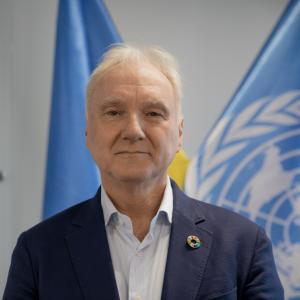
By Matthias Schmale, United Nations Resident and Humanitarian Coordinator in Ukraine.
Let me start with a very personal reflection. I was born in Botswana, in Southern Africa, before it gained its independence. At the time the country was in a period of transition from being colonized as the Bechuanaland Protectorate to becoming an independent nation. When someone asks me what independence means, I instinctively think of countries once colonized, gaining their freedom, sometimes through revolution and war, sometimes through negotiated political change.
Ukraine, in 2026, is not a country fighting for its independence. It declared independence in 1991 after the collapse of the former Soviet Union. What Ukraine is doing now is fighting to preserve it, against a reality that began in 2014 with the annexation of Crimea and escalated in 2022 into a full-scale invasion by the armed forces of the Russian Federation.
Recognition by the international community is a core element of independence. Formally joining the UN - founded in 1945 - has long been a form of recognition of a nation's independence by the world. One of the 51 countries that signed the UN’s Charter in 1945 was the Ukrainian Soviet Socialist Republic. When Ukraine became independent in 1991, it kept its membership in the UN and thus its recognition as an independent state.
Commemorating this 35th Independence Day in the middle of a war means is marked by Ukraine defending the independence and territorial integrity it secured 35 years ago.
What can Ukrainians expect from the UN in preserving its independence?
Our Secretary-General has remarked that the UN’s main tool for preventing and ending wars is not an army or weapons, but advocacy, speaking out, and upholding the UN Charter and International Humanitarian Law. Like people elsewhere facing war and conflict, I know Ukrainians watch closely what the UN says. The expectation is that the UN upholds its recognition of Ukraine’s territorial integrity within its 1991 borders, and that it names any violation of that territorial integrity for what it is.
A second instrument the UN has is peacekeeping: the UN has no army of its own, but can - on the basis of a Security Council resolution - deploy forces voluntarily provided by member states to keep the peace. As things stand, the Security Council has not mandated the UN to deploy peacekeeping forces to Ukraine.
Incidentally I have met Ukrainians who have proudly served in UN peacekeeping forces. And on June 5 this year Ukrainian Serhii Prykhodko was posthumously awarded the Captain Mbaye Diagne Medal for Exceptional Courage—the UN's highest peacekeeping honor. Serhii Prykhodko was a private contractor with a helicopter crew who served in the United Nations Mission in South Sudan. In March 2025, he volunteered to take the place of a less experienced colleague during a high-risk air evacuation to extract a group of besieged soldiers in the Upper Nile State. Tragically, Mr. Prykhodko lost his life, and two crewmates were injured when their helicopter came under fire during the mission. His actions and willingness to place himself in front of danger to carry out the mission helped save lives amid escalating violence in the area.
Could the UN play a role if a ceasefire agreement is reached?
There are too many unknowns to say what a future ceasefire agreement might look like, including how it would consider territory that is currently under temporary occupation. But whatever shape it takes, someone would need to monitor a ceasefire agreement, and using the UN’s vast experience and instruments would be one option. Subject to being mandated by Member States through its governance, the Seceretariat of the UN will always be ready to support the monitoring and implementation of a ceasefire, and hopefully one day a more comprehensive peace agreement.
What is the UN doing right now to help Ukraine preserve its independence?
As long as the war continues, at minimum we have to stand by the people of this country and help them deal with its impact. That is our humanitarian work: helping millions of people, in close cooperation with national authorities and mostly through non governmental organizations and civil society. It includes very concrete protection work, for example helping people who fled their homes and lost their documents re-establish their legal identity, and working with government and partners to protect and support survivors of conflict-related sexual violence.
It also includes early recovery. Any country that wants to preserve its independence needs functioning infrastructure and institutions. It is impressive to witness how much Ukraine has maintained functioning institutions into the fifth year of this war. A great deal of infrastructure has been destroyed - energy installations, warehousing, storage for agricultural products - and the UN has done considerable work helping to recover and rebuild it.
Throughout these years of war, the UN system has also worked with Ukrainian authorities to keep basic government services running such as health care, education, getting children back into classrooms. For me, this is part of independence too: a country cannot be viably independent without functioning public services that remain accessible to those most at risk of being left behind.
A “club” of members with rules and financial contributions
The UN belongs to its member states; it is, in a sense, a club, whose members determine its rules, including what constitutes an independent nation. That is why wars and invasions are debated in New York, at the General Assembly and the Security Council. Member states carry the responsibility of upholding the club's rules and calling on those who violate them to return to respecting what has been collectively agreed.
None of the concrete work I have described, humanitarian, protection, early recovery, is possible without the financial support of member states. The work we do depends on Member States footing the bill, just as Ukraine's ability to remain a functioning, independent country depends on their continued commitment.
With the backing of Member States, the 20 UN Agencies present in Ukraine with almost 3000 personell will through its humanitarian, protection, recovery, human rights monitoring and advocacy work maintain its commitment to Ukraine's citizens and their independence gained in 1991. And this commitment will not end when the war does; we will be here for what comes after, too.



Written by
UN entities involved in this initiative
Goals we are supporting through this initiative