UN Secretary-General calls on Member States to uphold UN Charter as foundation for peace, justice and shared future
[as delivered]
Madam President of the General Assembly, Excellencies, ladies and gentlemen, dear children,
The Charter of the United Nations begins with three simple words:
“We the peoples.”
Not we the powerful.
Not we the victorious.
We the peoples – all of us – bound by a single conviction: that we are safer, stronger and more human when we stand together.
The Charter was a promise to the world:
That humanity can choose cooperation over chaos; law over lawlessness; dignity over domination; and hope over fear.
A promise made from the ashes of war – and carried by every generation since.
For eighty-one years, we have strived to keep that promise alive;
Supporting peoples in their fight for self-determination and seating new nations as equals.
Through conflict and rivalry, through shocks and setbacks.
And to this day, we have never stopped – even in the hardest corners of the Earth:
Blue helmets standing between families and catastrophe.
Humanitarian convoys bringing hope to the starving.
Vaccines reaching the forgotten.
Mediators keeping a door open when every other door has closed.
International judges settling disputes between nations.
And development support helping communities build better lives.
Millions of people saved, protected and transformed.
The United Nations has never been perfect.
But it is irreplaceable.
Today, that promise is being tested to the breaking point.
We see it everywhere.
Wars of territorial expansion grinding on.
Famine used as a weapon and aid as a bargaining chip.
Civilians treated as targets.
Ceasefires proclaimed one day, and shattered the next.
The nuclear shadow we swore to rub out, lengthening once more.
International law invoked when convenient – and ignored when not.
Inequalities and mistrust widening.
A world where the rules apply only to some is not a world of order.
It is a world of uncertainty, injustice and impunity.
Some tell us the answer to this turbulence is to retreat – behind walls, behind borders, behind the comforting fiction that any nation can weather the storms of our age alone.
They are wrong.
Retreat is not safety.
It is surrender.
No border can hold back a warming planet.
No country can govern artificial intelligence alone, end a pandemic alone, or shield its people from global shocks alone.
In a world of shared dangers, cooperation is not naïveté.
It is the clearest-eyed realism there is.
But cooperation only works when it is grounded in rules.
Rules that apply to all.
Rules that protect all.
Rules set out in the Charter.
I’ve said it before: the Charter is not an à la carte menu.
Its principles are not optional, and they are not negotiable.
They demand respect for the sovereign equality of all States.
They prohibit the threat or use of force against the territorial integrity or political independence of any State.
They require that international disputes be settled by peaceful means.
And that human rights be upheld without double standards.
They give every Member State a choice and every people the protection of the law.
When these foundations are weakened, every country is less secure.
That is why we must uphold the Charter’s purposes and principles and respect international law, including international humanitarian law.
We must strengthen diplomacy and solidarity across regions, and accelerate action on sustainable development – because peace, dignity and opportunity go hand in hand.
And we must build a United Nations that adapts to a changing world.
Excellencies,
Yes, we must reform.
The Security Council must reflect the world of today, not the world of 1945.
The same applies to the international financial architecture.
And the United Nations itself must continue to evolve – through the UN80 Initiative and beyond – to serve with greater efficiency and impact.
But reform must strengthen the United Nations – not weaken it.
The answer is not less cooperation.
It is stronger cooperation.
Cooperation rooted in the Charter – and in the simple truth that our futures are bound together.
Cooperation that rebuilds trust through action, defends the principles that bind us, and proves that multilateralism can deliver for people.
That is the spirit of this gathering:
Better together.
One Charter.
One future.
The Charter was born from catastrophe – and from the courage to build a better world.
That work is unfinished.
And it falls to us.
To uphold the Charter.
To strengthen the United Nations.
To choose – again – peace, justice and our common humanity.
And prove what becomes possible when “we the peoples” act as one.
Thank you.



Speech by
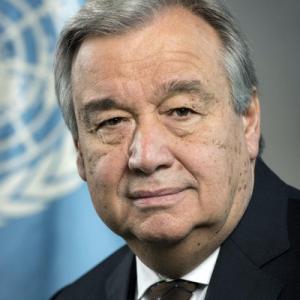
António Guterres
Goals we are supporting through this initiative