
After Four Years of Relentless Attacks, Ukrainian People Remain Determined to Build a Better Future and Not to Give Up
24 February 2026
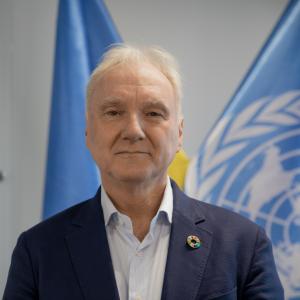
Statement by the UN Resident and Humanitarian Coordinator in Ukraine, Matthias Schmale, on the fourth-year mark of the Russian Federation’s full-scale invasion of Ukraine
Today marks four years since the start of the full-scale invasion of Russia into Ukraine in 2022. Ukrainians continue to be confronted with destruction, death, injury, and displacement.
In early February, I visited a family in Tsyrkuny, a village in the Kharkiv region, less than twenty kilometres from the front line. The community lives under constant shelling, with unreliable access to electricity and heating. This family has chosen to stay, despite the danger, to care for their three children, including a son with a disability.
One moment from that visit has stayed with me. They told us they had received seeds, but were unsure whether to plant them this spring, as hostilities were moving closer to their home. That uncertainty captures where Ukraine stands today after years of relentless war: at a crossroads. Wounded, unsure, tired, but still determined to build a better future.
For many, the horror of war did not begin four, but twelve years ago. Every day, families face impossible decisions: Is it safe for my child to go to school? Can we survive winter without heating? Is my home a safe place, or could it be hit? Will tomorrow be better or worse?
The scale of suffering remains staggering. An estimated 10.8 million people across Ukraine are still in urgent need of humanitarian assistance. Another million people in the parts of Donetsk, Kherson, Luhansk and Zaporizhzhia regions of Ukraine under the occupation of the Russian Federation also need support. Some 3.7 million people remain internally displaced, and nearly six million have sought refuge abroad.
Families who once had stable homes, jobs and businesses now struggle to get by. Repeated attacks on energy infrastructure, with temperatures dropping to –20°C, have left families in high-rise buildings without heating, electricity and often water. This hardship touches nearly every household and every community. I want to reiterate that attacks on civilians and civilian infrastructure are a violation of international humanitarian law. The weaponization of energy against civilians is unacceptable.
As the war continues, needs evolve. Those who lost their homes are now in need of more long-term solutions for housing and jobs. They need hospitals and schools for their children to be rebuilt. And countless people need mental health support. Every Ukrainian is living through a hidden crisis: the psychological toll of war. For many, devastating experiences include surviving conflict-related sexual violence, fleeing homes behind, losing friends, family, or connection with them.
As I travel around the country, I can see increasing fatigue. People are getting tired, understandably, but they are not giving up. This goes beyond resilience: this is a conscious choice to endure, to push forward and to persevere, despite the high cost. Let's honour this strength that the Ukrainian people continue to show, striving for a better life against all the odds: If nothing is planted, nothing can grow.
We must ask ourselves: what seeds can we plant today? What can we do better? Can we repair or build schools so that children do not lose their future along with their childhood? Can we provide dignified housing for displaced families? Can we support women in gaining new skills, starting businesses, rebuilding livelihoods and enhancing meaningful participation in decision-making? Can we invest in green and resilient energy solutions, even amid an ongoing energy crisis? Can we expand trauma care for veterans and survivors of war crimes and conflict-related sexual violence?
I believe we can and that we already do, working together with the Government of Ukraine, our partners and our donors to not only deal with today, but prepare for a stronger and more hopeful tomorrow. I call on Member States, organizations, the private sector and individuals to sustain their support for Ukraine. Every act of solidarity matters. Every contribution changes lives.
And I hope that this year will bring lasting and just peace, in line with the UN Charter and international law. A peace that allows us to see crops growing tall from the seeds planted by a family in Tsyrkuny.



UN entities involved in this initiative
Goals we are supporting through this initiative
